National Dissemination Event at mdw: A Vision of an Open, Democratic Europe
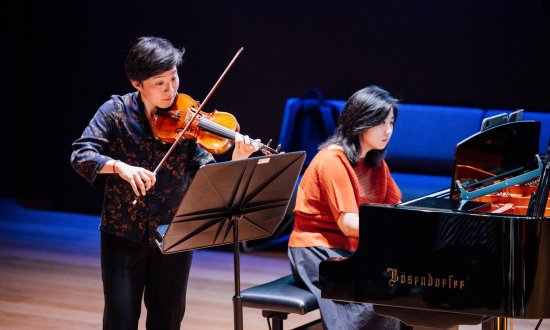
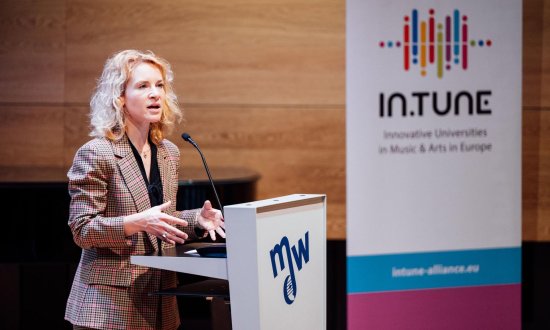
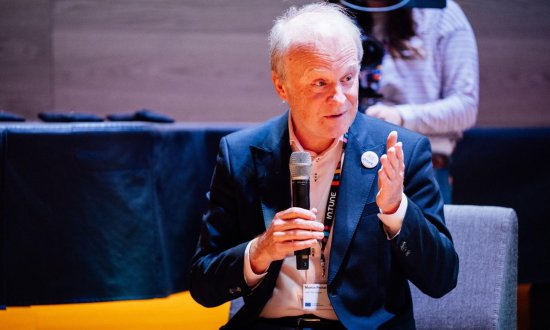
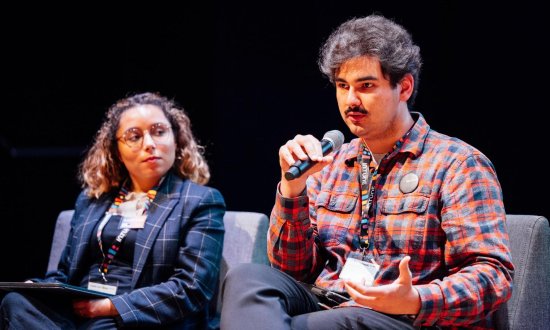
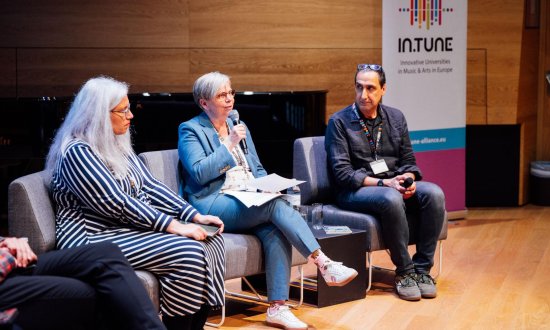
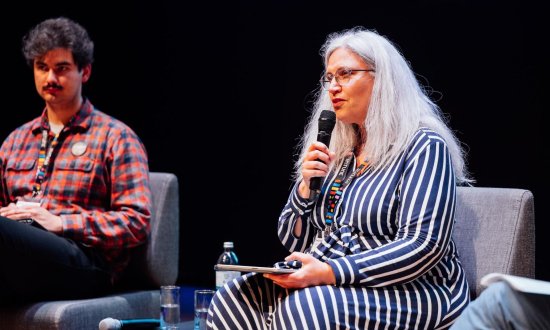
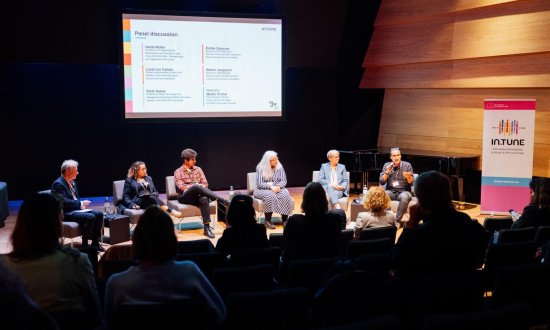
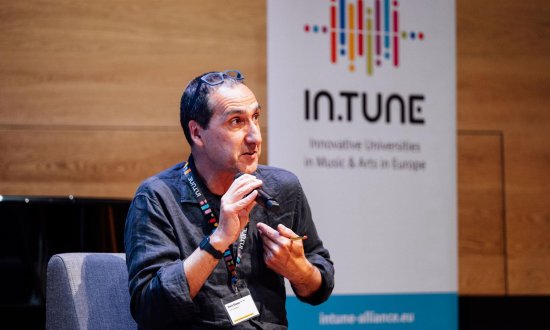
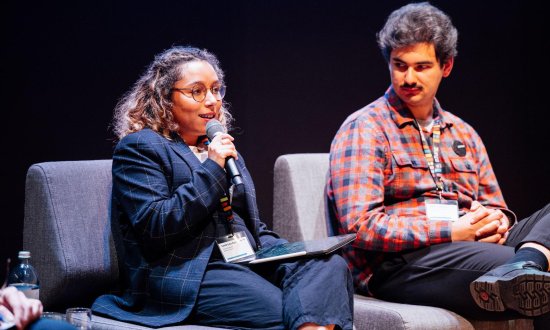
The European Universities Alliance IN.TUNE – Innovative Universities in Music and Arts in Europe recently celebrated one of its milestones at the mdw: the first IN.TUNE Summit. In a packed programme presented from 11 to 13 May 2026, some 250 participants from the IN.TUNE partner universities dedicated themselves to the long-term further development of the alliance and the intensified exchange among the institutions.
What is IN.TUNE, and what is the special importance of this European Universities Alliance? Get to know IN.TUNE session, held in the Konzertsaal of the mdw’s Future Art Lab, invited interested participants to join representatives of IN.TUNE in surveying the Alliance’s work and future.
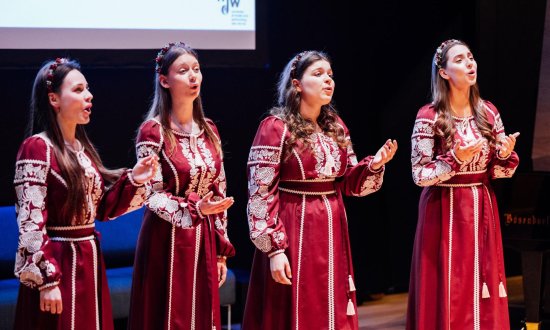
A musical introduction was provided by the student vocal ensemble “Lybid” from the Ukrainian National Tchaikovsky Academy of Music, an IN.TUNE Associate Partner.
A shared commitment to an open and democratic Europe
The event was given special significance by the presence of Eva-Maria Holzleitner, Austrian Federal Minister for Women, Science and Research, who opened the summit along with mdw Rector Ulrike Sych. Minister Holzleitner underscored the role of IN.TUNE as the only European Universities Alliance in the area of music and art:
“IN.TUNE stands for a Europe that is open, democratic, cooperative, and culturally ambitious. Universities are not only places for learning and research; they are also places where democracy is lived. This is particularly true for universities of music and the arts, where freedom of expression, creativity, and reflection are at the very heart of academic and artistic work.”
For mdw Rector Ulrike Sych, IN.TUNE is much more than a cooperation:
“IN.TUNE is a transformation process that structurally anchors international collaboration even stronger on all levels: in teaching, in artistic research, and in administration.” A loyalty among IN.TUNE partner institutions has developed; they support each other in the case of the danger of political influence exerted on the partner universities. “IN.TUNE contributes to the strengthening of democracy and democratic values. We share a commitment to protecting the dignity and rights of people, to equity, transculturality, diversity, and to the freedom of science and research,” stressed Rector Sych.
Building long-term European cooperation in music and the arts
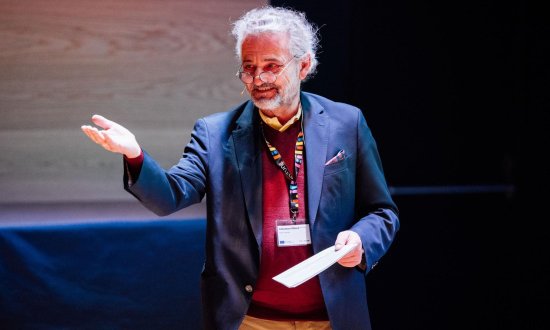
Johannes Meissl, the mdw Vice Rector for International Affairs and Art, presented a number of facts about IN.TUNE, one of 73 European Universities Alliances (with a total of 650 participating universities of various types). The IN.TUNE partner universities – Norwegian Academy of Music (Oslo), National University of Music Bucharest, Conservatoire National Supérieur de Musique et de Danse de Paris, Uniarts/Sibelius Academy (Helsinki), Escola Superior de Música de Catalunya (Barcelona), mdw, University of the Arts/Royal Conservatoire (The Hague), and University of the Arts Belgrade – pool their expertise with 18 associate partners. Proven cooperation, excellent reputations as a higher music education institutions in their respective countries, and the broad geographical expansion that stands for a variety of traditions and approaches all make up the basis for the union of these renowned partners. Each university is responsible for one of the eight Work Packages. The development of joint courses, degree programmes, and innovative teaching and learning formats, and the creation of frictionless pathways for students and faculty to move between partner universities, research collaborations, and joint policies are the key objectives of IN.TUNE’s work. Vice Rector Meissl emphasised that IN.TUNE has become part of the mdw’s “institutional DNA”, and that the university intends to continue pursuing this transformative path.
Student voices at the centre of the Alliance
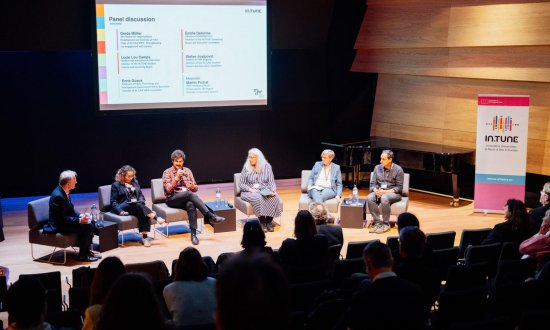
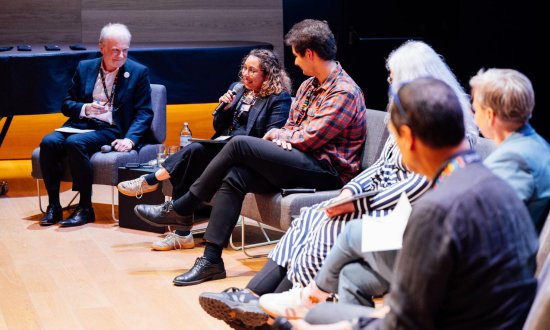
The subsequent panel discussion, featuring the perspectives of students, teachers, and rectorate members, was moderated by Martin Prchal, Vice-Principal of the Royal Conservatoire The Hague and IN.TUNE Co-Secretary General. Among other things, Prchal stressed the role of students in the Alliance, who with their own Student Council and with student representatives on all levels of IN.TUNE are at the centre of the Alliance’s work.
Stefan Josipović, a student at the University of Arts Belgrade and member of the Student Council and the Executive Committee, spoke of the important significance of IN.TUNE during the Serbian student protests. When the canopy of the main railway station in Novi Sad collapsed in November 2024, sixteen people were killed. Students responded by organising blockades and protests to address the corruption and failings of the government and authorities and to bring about change. This protest movement is still active today. For Josipović, the role of IN.TUNE during this difficult period was of great value: “IN.TUNE was there to help, both emotionally and in any other way it was able to. The student offered the perspective of a non-EU country:
“It’s hard to stay connected with the European artistic currents, which are so close to us, but hard to grasp and get involved in. This is where the Alliance comes in. It creates these connections and opportunities and builds bridges to places such as ours, which are to a smaller extent connected.”
From institutional change to social engagement
Gerda Müller, mdw Vice Rector for Organisational Development and Diversity and chair of Work Package 6, “Strengthening our Engagement with Society”, stressed why social engagement is not optional for universities but of vital importance:
“Music has a unique capacity to contribute to our shared civic life. It can connect people from different cultural and social backgrounds. IN.TUNE allows us to pool knowledge, align values, and work together, so that our graduates can grow artistically and personally while contributing to a more inclusive, sustainable, cultural ecosystem.”
Émilie Delorme, Director of the Conservatoire National Supérieur de Musique et de Danse de Paris and member of the IN.TUNE Governing Board and Executive Committee, is grateful for what the IN.TUNE institutions can learn from each other. Political and economic instability, as well as the speed of transformation, have an impact on the career path of students. IN.TUNE, she said, offers a chance to address the challenges of our time:
“Now we are structured within IN.TUNE; we know each other and have common values and goals. Our main challenge now will be to scale up all that we developed. I think we all love challenges.”
Enric Guaus, professor in the Department of Music Technology and Management of the Escola Superior de Música de Catalunya (ESMUC) in Barcelona and member of the Work Package 6 Committee, offered a view of IN.TUNE and the effected change processes from the perspective of a teacher. He gave as an example how the ESMUC’s rector sharpened the focus on diversity and inclusion issues when she assumed office. This gradually became more natural for the teachers. It was similar with IN.TUNE:
“With IN.TUNEwe are somehow planting the seeds. IN.TUNE is changing the mindset of the institution, and I think that’s important. When the mindsets change, then we have a real impact.”
Lucie Lou Camps, student representative from the Norwegian Academy of Music Oslo and member of the Student Council and Governing Board, explained how IN.TUNE impacts her day-to-day student life, giving as an example her most recent Monday. Upon closer inspection, she observed, “IN.TUNE is everywhere”: In the classes taught by teachers from the IN.TUNE partner universities, in the planning of a trip to the partner university in The Hague, or when a colleague from the Student Council explains to her the correct pronunciation of a Catalan song she is rehearsing.
IN.TUNE is everywhere: this creed is a motivation and inspiration for the partner universities to join together to shape the innovative present and future of the Alliance.
Text: Isabella Gaisbauer/ mdw
Photo: Daniel Willinger / mdw