Student Perspectives on Supervision and Mentorship: Reflections from AIRE 2026 in Oslo

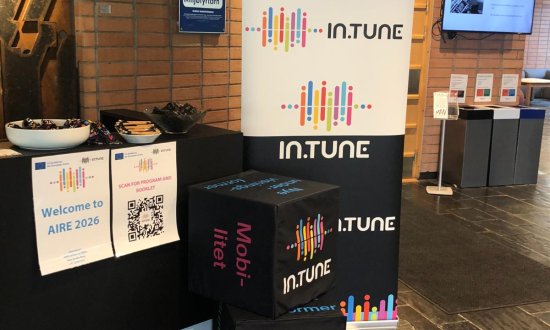
What do supervision and mentorship mean in today’s higher music and arts research education? From a student perspective at the AIRE2 Conference – “Research Education and Supervision in Focus”, held in Oslo on 8–9 April 2026, Alex Musat from the National University of Music Bucharest reflects on the event, sharing his insights into topics central to the IN.TUNE alliance: how research-based education and effective supervision can shape learning, creativity, and future careers in music and the arts.
Arriving Early, Unexpected Encounters
AIRE 2026 – Arriving Early, Leaving Inspired
I arrived in Oslo two hours early for a conference that I was absolutely determined not to miss. This was not because I am exceptionally organized, but because I am exceptionally good at imagining worst-case scenarios involving missed flights, missed trains, and academic disasters. If you’ve seen the movie Planes, Trains and Automobiles, then you know what I’m talking about.
So there I was, far too early at the Norwegian Academy of Music, fully prepared to spend a morning scrolling on TikTok and thinking about ways to kill the next two hours. Instead, something unexpected happened. Two of the organizers, Anniina and Gina, noticed me waiting, and offered to give me a free tour of the Academy. I later found out that the tour was free anyway, but it still made me feel like some kind of VIP guest who had shown up for a private visit. This was also my first time in Norway, which added a quiet layer of excitement to everything (picture me trying to find a vegetarian sandwich in Sandefjord at 12AM; not a very bright idea.)
Research, Supervision, and Shared Academic Spaces
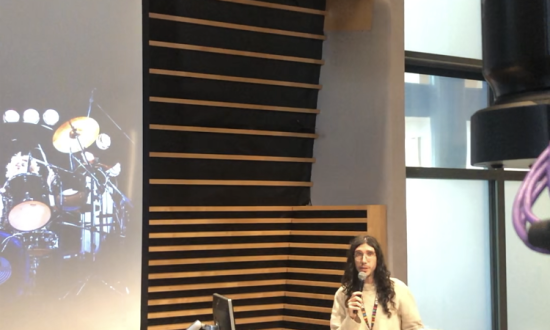
AIRE 2026 – Research Education and Supervision in Focus (8–9 April 2026) brought together academics, educators, and students from across Europe to discuss supervision, mentorship, and research in higher music and arts education. I attended as a speaker, presenting my PhD thesis, The Drummers of 1970s Progressive Rock: Origins, Influences, and Elements of Language. Coming from the National University of Music in Bucharest, an institution traditionally associated with classical music, my work already sits slightly outside the expected framework.
The central theme of the conference mirrored my own experience. In my presentation, I spoke about how my research was made possible through openness, and not rigid academic hierarchy. My supervisor and committee didn’t impose direction from above; instead, they engaged in a kind of shared exploration. It felt less like being “guided” and more like being taken seriously as a researcher. Looking back, it’s clear that without that openness, I wouldn’t have made it to Oslo to present at all. After all (and this is a quote from my presentation), why is a Beethoven manuscript considered worthy of study, but not the way Ringo Starr wrote The Beatles on his bass drum? Both can be analyzed, and both tell a story.
Listening to other participants, I realized that the question of how supervision can support rather than constrain was present across institutions in Europe. Different conservatories, different traditions, but often similar challenges. For instance, teachers in Belgrade promote discussion instead of a top-down teaching approach. Meanwhile, researchers in Paris recommend that students read fiction from the same period in which the musical piece was composed. That shared desire to change supervision created a sense of quiet solidarity: we were all, in different ways, trying to figure out how to make research spaces more flexible, more inclusive, and more responsive to individual paths.
Encounters, Mobility, and Leaving Inspired
I met people from Belgrade, Barcelona, Helsinki, and Paris, some of whom I had only seen before on a screen. There’s something oddly satisfying about finally shaking hands with someone you’ve previously only encountered in a Zoom meeting. The conversations were easy, open, and often continued long after the official sessions had ended. At one point, I found myself talking to a student at the Academy about Norwegian folk drumming. We discussed instruments made with animal skins, similar to the ones some Romanian rock drummers used in the early 70s. It was one of those conversations that you don’t expect to have, but that stays with you because it shifts your perspective, even slightly.
Here’s one of my favorite Joni Mitchell lyrics, from her 1976 song, “Black Crow”:
“I took a ferry to the highway
Then I drove to a pontoon plane
I took a plane to a taxi
And a taxi to a train.”
This was basically me, minus the pontoon plane. I took a bus from Bucharest to Otopeni Airport, a plane to Torp Airport, an Uber to Sandefjord, a train to Oslo, the subway to the Norwegian Academy of Music, another train back to Sandefjord, a bus to Torp Airport, a plane to Otopeni Airport, and an Uber back home, all in less than 48 hours. Surprisingly, none of them were delayed or involved in some catastrophic accident.
In the end, AIRE 2026 was about experiencing what academic life can feel like when it is open, generous, and human. From an unexpected tour to conversations about drums and tradition, the conference reminded me that the most meaningful parts of research are often the least formal ones. And sometimes, arriving too early turns out to be exactly the right decision.
Photo and text credits: Alex Musat