Building Transnational Pathways in Early Music Education: IN.TUNE Heads of Early Music Departments Meet in The Hague
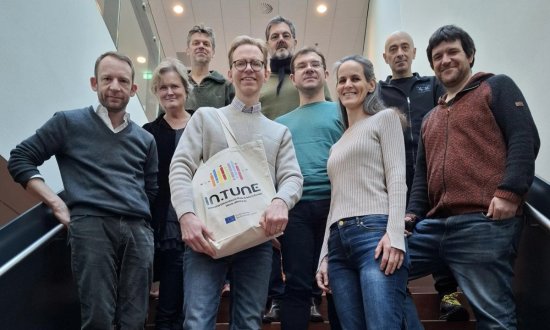
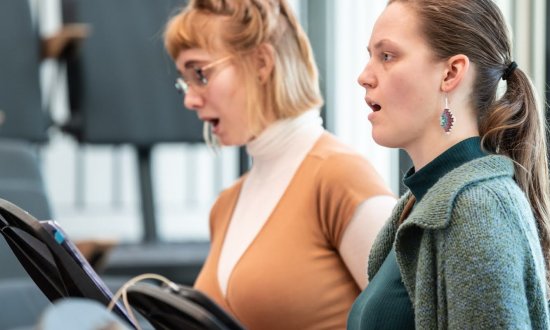
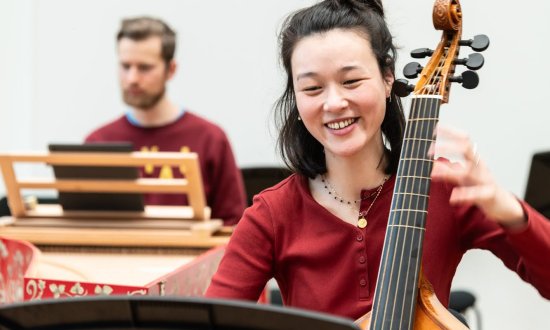
After a successful meeting of the Heads of Vocal Departments in November, the Royal Conservatoire The Hague hosted an in-person meeting of Heads of Early Music Departments and equivalent representatives from across the IN.TUNE Alliance. Eight colleagues from partner institutions came together on 23-24 January 2026 to exchange perspectives, explore shared challenges, and lay the foundations for future collaboration in early music education.
“As heads of departments, we rarely have the opportunity to sit down together and speak openly about our realities,” said Teunis van der Zwart, Head of the Early Music Department at the Royal Conservatoire The Hague. “This was the first time we came together as a group within IN.TUNE to explore what collaboration could really mean for our departments.”
A shared starting point
The initial focus of the meeting was getting to know one another: institutional structures, educational models, and the day-to-day challenges of running early music programmes. While the departments differ in size and organisation, many challenges proved to be shared.
“Early music covers an enormous historical and stylistic range,” Van der Zwart explained. “Students often ask why certain periods or specialisms are not offered. The honest answer is usually a lack of time, staff, or resources. And we realised very quickly that this is something many of us face.”
According to Pascal Bertin, Head of the Early Music Department at the Conservatoire National Supérieur de Musique et de Danse de Paris (CNSMDP), this recognition created immediate openness: “In many ways, we all deal with the same questions. What becomes interesting is seeing how each institution finds its own solutions, and how we might share those solutions rather than reinventing them separately.”
From staff mobility to student opportunity
While the meeting centred on staff exchange and strategic dialogue, its ultimate focus was student benefit. Participants repeatedly returned to the question of how collaboration at the departmental level could translate into concrete opportunities for students.
“One idea that resonated strongly was the notion of specialisation,” Bertin noted. “Not every school needs to offer everything. Instead, we could imagine each institution developing a particular strength like Renaissance repertoire, medieval music, or improvisation, and opening that expertise to students across IN.TUNE.”
This approach could take shape through Blended Intensive Programmes (BIPs), short-term mobility, shared masterclasses, or hybrid formats combining online and in-person teaching. For students, this would mean access to a broader and more specialised educational offer without having to commit to long-term relocation. Another concrete outcome discussed was student exchange for project-based work. Smaller departments or institutions without a formal early music department often struggle to assemble full ensembles.
“Through IN.TUNE, we could support each other very practically,” Van der Zwart said. “If one institution lacks a specific instrument for a project, students from another partner could join, supported by Erasmus+ funding. That is a direct and tangible benefit for students.”
The Ton Koopman Academy as a model
Throughout the meeting, the Ton Koopman Academy was repeatedly referenced as a strong example of what transnational collaboration within IN.TUNE can look like in practice. Originally established at the Royal Conservatoire to honour Ton Koopman and maintain his active involvement after his retirement in 2018, the Academy has gradually evolved into an international project.
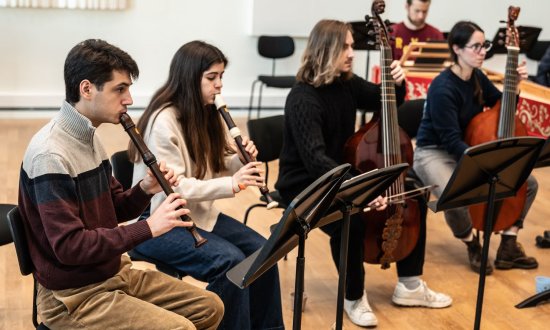
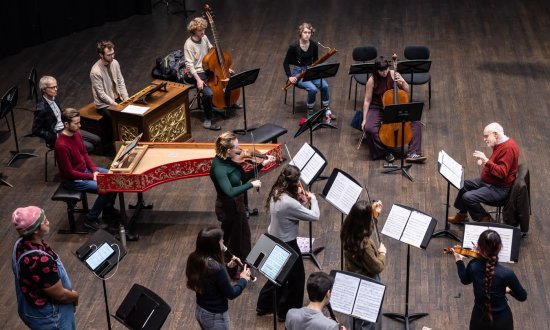
Today, the Ton Koopman Academy brings together students and teachers from multiple IN.TUNE partner institutions through a Blended Intensive Programme format. Each year, a small group of students from partner conservatoires join KC students for an intensive week of individual lessons, group sessions, rehearsals, and performances under Ton Koopman’s guidance.
“The Royal Conservatoire is a beautiful place, with excellent facilities and inspiring teachers. Having the opportunity to work with someone like
Ton Koopman is a great chance that really helps you grow as
a musician.”
— Théo Mazurie, Viola da gamba, CNSMD Paris
The educational value of this model is clear. Students benefit not only from working with a leading figure in the early music field, but also from close collaboration with peers from different cultural and educational backgrounds. For staff, the Academy demonstrates how shared ownership, coordinated mobility, and aligned curricula can result in a learning experience that is richer than what any single institution could offer alone.
The long-term ambition is to further embed the Ton Koopman Academy and similar projects within IN.TUNE and gradually expand participation so that students from more partner institutions can benefit from this model of cooperation.
“I would definitely encourage students to join a blended intensive
project. You are challenged to adapt quickly,
discover new ways of working, and grow both musically and personally.”
— Arià Campos Regi, Recorder, ESMUC Barcelona
Building a shared future for early music
Beyond concrete projects, the meeting strengthened the sense of belonging to a wider IN.TUNE community. Participants emphasised that they are not only educators, but also active musicians, deeply engaged with the future of early music as an artistic field. Discussions therefore extended beyond curricula to broader questions: how has early music changed over the past decades? How does it relate today to modern orchestral practice? And how can education respond to these developments?
As a next step, the group will remain connected through a shared communication platform, enabling continuous exchange, peer consultation, and the development of joint initiatives. What began as a staff mobility meeting thus becomes the starting point for sustained collaboration, one that enhances educational quality, broadens opportunities for students, and strengthens early music within the IN.TUNE Alliance. These efforts will continue across departments in the framework of Work Package 2 Seamless Mobility for Students and Staff.